Back to our work
Financial adviceDocument AI2025

One meeting, two documents, two readers.

The file note and the Record of Advice, written from a single recorded meeting.

The challenge

After every advice meeting, an adviser owes two pieces of writing: a file note, kept internally for the practice and the regulator, and a Record of Advice, or ROA, the written advice the client receives. Same facts, two entirely different voices.

Keeping up had come to mean hiring people whose whole job was drafting them.

Now that meeting becomes both documents in minutes, in the practice's own words, with no one added to write them.

ScopeFile note + Record of Advice
Section agents14
Advice templates10
Core stackGPT-4o · FastAPI · SQLite
ArchitectureFile note first
GuardrailSummarise, never extract

We asked to sit in on the training.

Before writing any code, we watched what the practice teaches a new paraplanner. One detail there decided the entire architecture, and we would not have guessed it from a transcript.

Nobody writes the Record of Advice from the transcript. They write the file note first, then write the ROA from the file note.

The obvious build
TranscriptRecord of Advice
What the practice does
TranscriptFile noteRecord of Advice

So the system does the same. The ROA generator never sees the transcript. It reads the finished file note, exactly like the person whose job it replaced.

The same meeting, written twice.

On the left, the note that goes in the file. On the right, the letter the client reads. Nothing on the right is new. Scroll, and watch it write itself from the file note, line by line.

File noteEllison, M. · 14-07-2025 · FN.docx

Where You Are Now

Client is 61, working full time, and intends to reduce to three days per week from October. Current accumulation balance discussed. No change to household expenditure expected in the near term.

Superannuation

Reviewed the existing accumulation account and current contribution arrangement. Client acknowledged that concessional contributions will fall in line with the reduction in hours.

Retirement Planning

Discussed the income shortfall created by moving to three days per week. Reviewed commencing a transition to retirement pension to supplement income while preserving the long-term balance. Client agreed to proceed on the minimum annual drawdown.

Consent Form

Ongoing fee consent discussed. Client confirmed they are comfortable with the current arrangement and will sign at the next opportunity.

Scope In

Transition to retirement strategy and the associated pension commencement.

Action Items

  • Adviser to prepare the TTR commencement paperwork.
  • Client to confirm the reduced-hours start date with their employer.
  • Adviser to send the ongoing fee consent form for signature.
The other eight sections produced nothing, so they are not here.
Record of AdviceTTR Withdrawal · sent to the client
SubjectYour transition to retirement pension

Dear Margaret,

Thank you for making the time to meet last week. It was good to hear that you are planning to move to three days a week from October.

As we discussed, reducing your hours will leave a gap in your income. To cover it, I have recommended that you start a transition to retirement pension using your existing super balance, and draw the minimum amount each year. This lets you supplement your income now without drawing down your long-term savings any faster than you need to.

One thing to keep in mind: because you will be working fewer hours, the contributions going into your super will reduce as well. We have factored that in, and we will revisit it at your next review.

  • Please sign and return the commencement form attached to this email.
  • Please let me know once you have confirmed your new start date with your employer.

If anything here is unclear, or if your plans change between now and October, please call me.

Every client action begins with “Please”

Not our idea. It is in the practice's own template, because an instruction a client skims has to read as an instruction.

Ticker codes get expanded

A client email never says VAS. It says the full name of the fund. The file note is allowed to say VAS, because a colleague reads it.

Whose fee is it

Where a platform charges brokerage, the template makes the email say so, so a client never reads a platform's fee as the adviser's.

Ten templates, one per kind of advice, every one the practice's own writing.
Annual Review SummaryCash Top-Up (SMSF)Ad Hoc Pension WithdrawalTTR WithdrawalETF Purchase (Minor Account)Switch to EquitiesRebalance with Client Consent ConcernSwitch (Consent Required)New Insurance (Outside SOA)Hold Email

Fourteen sections. Fourteen agents.

The file note has one fixed shape, and the practice had used it for years. We made that shape the architecture. A section nobody discussed writes nothing, and so does a section that was discussed but reached no decision.

  • Where You Are Now4 passages
  • Superannuation7 passages
  • Personal Insurancediscussed, no decision
  • Estate Planningnot discussed
  • Investments Outside Supernot discussed
  • Propertynot discussed
  • Retirement Planning9 passages
  • Renewal Strategynot discussed
  • Consent Form2 passages
  • Action Items5 passages
  • SOA Goalnot discussed
  • Scope In2 passages
  • Scope Outnot discussed
  • General Purposenot discussed
7never discussed, so they write nothing
1discussed, but no recommendation and no client decision, so it stays empty rather than inventing sensible-sounding advice
6had something real to say, so the note is exactly 6 sections long

A file note from this system is never padded to a template. It is as long as the meeting was.

An adviser finishes a call and uploads it.

Pick the client, pick the kind of advice, and both documents come back written. Here is the tool doing exactly that.

01
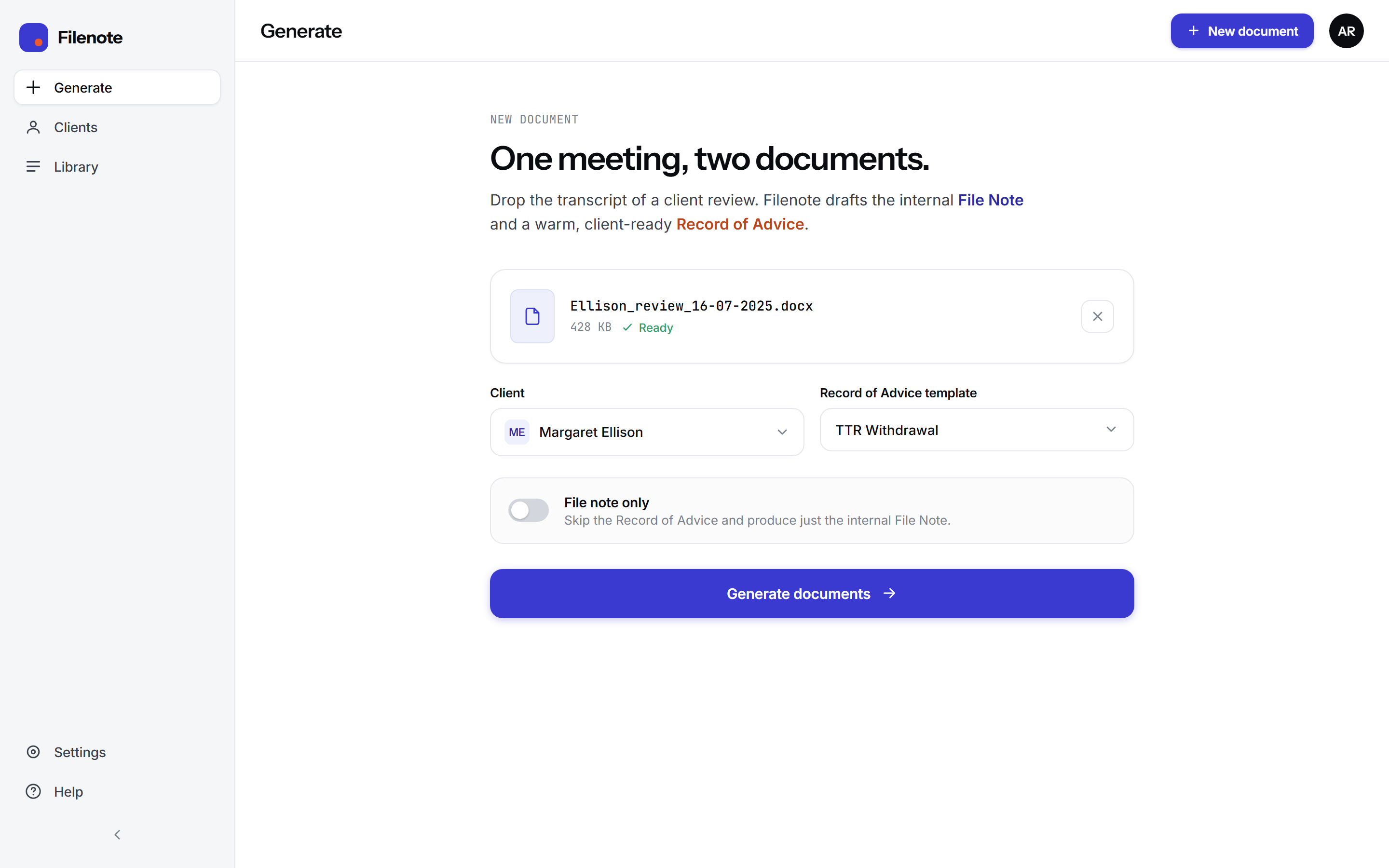
Drop the transcript, pick the client and the kind of advice.
The Filenote generate screen: a transcript uploaded, a client and a Record of Advice template selected, ready to generate.
02
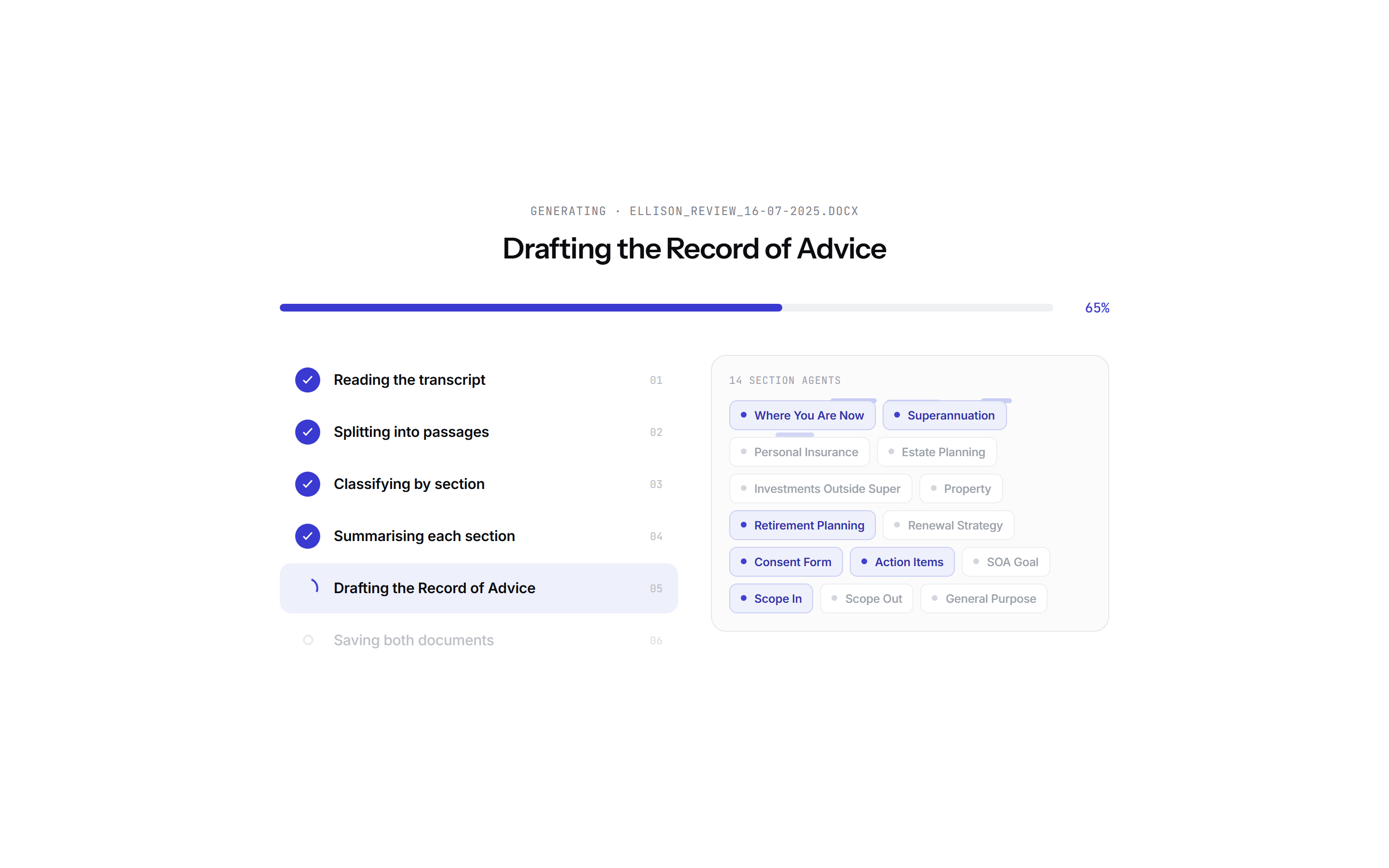
It reads, splits, classifies, then drafts. The sections with content light up.
The processing screen: six named stages with the fourteen section agents, the six that had content lit in indigo.
03
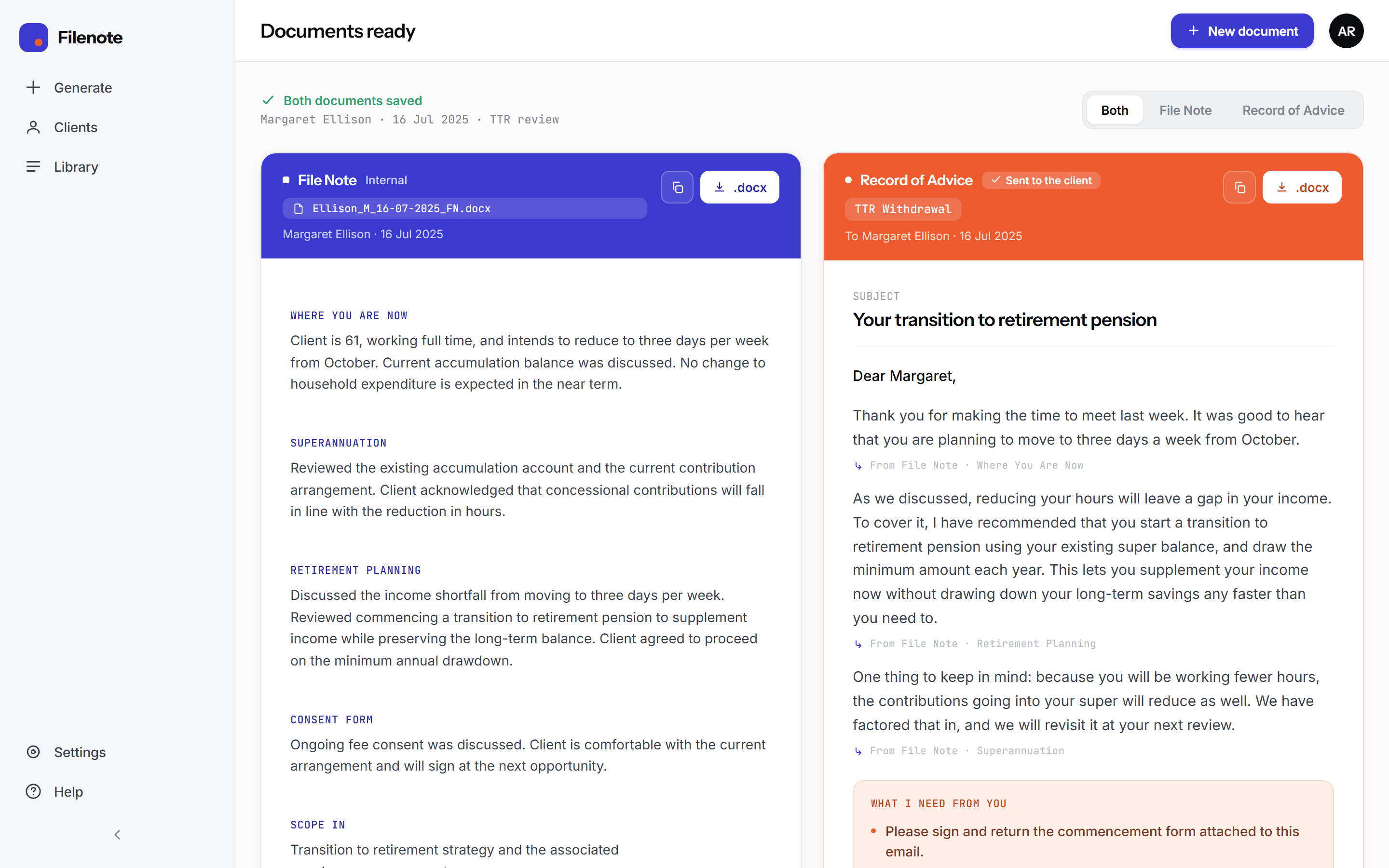
Both come back, the file note and the client's letter, side by side.
The result screen: the File Note in indigo beside the Record of Advice in coral, each line traced to its source section.

The model is the smallest part.

The pipeline is the interesting engineering, but a practice needs a product around it: somewhere to keep clients, find past documents, and handle the meeting that fits no template. We built that too.

What the practice uses
  • A transcript in .docx, PDF or text, both documents back in minutes
  • File-note-only mode, for meetings that need no Record of Advice
  • Ten advice templates, plus a path to request one we do not have
  • Client records, each with its full document history
  • A library of every document produced, across clients, newest first
  • Named, collision-safe files for the file note and the ROA
How it holds up
  • Every section is a summariser, never an extractor
  • Nothing is written unless it was discussed and a decision was made
  • Near-duplicate passages removed before a word is summarised
  • Each of the fourteen agents is its own endpoint, testable alone
  • Malformed model output degrades to unclassified, it never breaks a run
  • A progress bar named to the real stage, not a spinner
How we work

Learn the job before automating it

We sat in on the paraplanner training. What we learned there decided the architecture.

The client's expertise stays theirs

The advice templates were wired in unchanged, so the firm's language survives contact with the model.

Build for the edge cases you have not met

The practice ran the tool on live meetings before anything was automated end to end.

If the writing about the work has become the work, that is a conversation worth having.

Talk to usWe take on regulated, document-heavy problems in any field, not only financial advice.
More of our workSee all projects